Frequently Asked Questions
Find answers to common questions about our services and solutions.


Kaldor helps organizations design, build, operate, and govern AI systems that reduce cost, improve decision-making, and perform reliably in production.
Most AI initiatives fail before they ever deliver business impact. Strategic misalignment, weak data foundations, scaling challenges, and human resistance prevent AI from delivering sustained business value.
AI initiatives are often launched due to competitive pressure rather than a clearly defined business objective.
Fragmented data, legacy systems, and inconsistent data quality undermine model performance and make scaling impractical.
AI solutions that succeed in pilots frequently fail to scale due to lack of integration, monitoring, and a product-level operating mindset.
Low adoption, skill gaps, and missing executive ownership prevent AI systems from being trusted, used, and sustained.
We identify high-impact opportunities tied to cost reduction and productivity.
Our team design and build lean software and AI that fits how your teams actually work.
We integrate, monitor, and continuously optimize performance.
We apply clear governance, access controls, and accountability.
We ensure transparency, stability, and long-term operational trust.
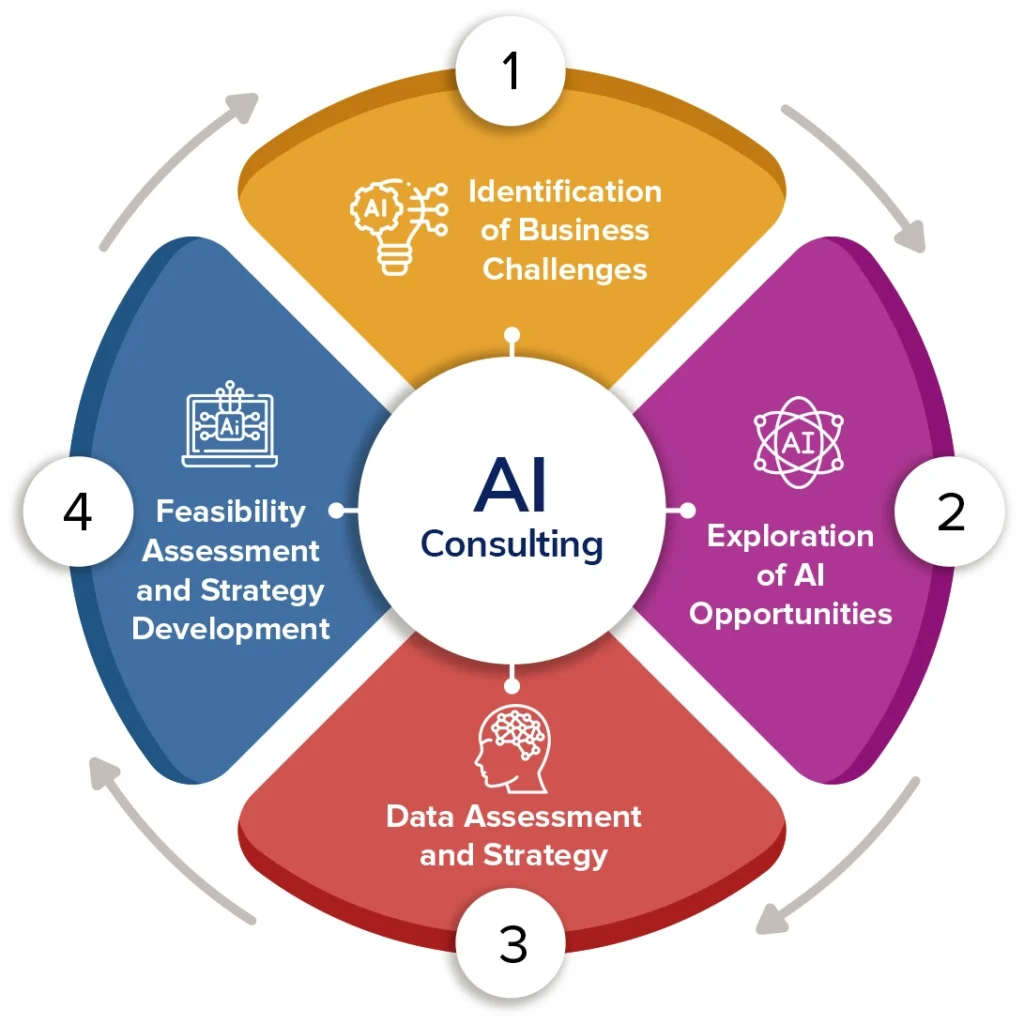
We focus on where AI should be applied, where it should not, and what must be in place for it to succeed at scale. Clear, actionable AI strategy that leadership can defend, teams can execute to help the organization scale.
We design and implement AI systems that integrate directly into existing workflows, data platforms, and decision processes. Our core focus is on production-ready execution systems that perform reliably, scale with demand, and deliver measurable operational impact.
AI systems change over time. Data shifts. Usage patterns evolve. Business priorities move.
We help companies keep AI systems effective by tracking performance in real operations and improving them continuously so they remain reliable and valuable
We monitor how AI systems perform every day across accuracy, speed, reliability, and decision quality. This gives teams early warning when results start to drift or performance drops, so issues are fixed before they affect customers or operations.
Some decisions need human judgment. We design clear checkpoints where people can review, approve, or intervene in AI-driven decisions. This keeps accountability clear while allowing automation to move fast where it should
AI should deliver measurable results. At Kaldor our expert team tracks whether automation is reducing costs, saving time, or improving outcomes. This helps leaders understand what is working, what is not, and where to invest next.
Without clear governance, automation increases operational, regulatory, and reputational risk often invisibly.
Kaldor helps organizations establish practical AI governance that enables scale while maintaining accountability, compliance, and trust.
We focus on governance that works in day-to-day operations, not policies that sit on paper.




Separate from system design and delivery
Grounded in data, metrics, and observation
Focused on improvement, not blame
As AI systems take on more responsibility in business operations, leaders need confidence that these systems behave as expected. Trust is built through verification, not assumption.
Kaldor provides independent AI assurance and validation to help organizations confirm that their AI systems are accurate, reliable, compliant, and aligned with business objectives. Our work supports informed decisions by leadership, regulators, and stakeholders.
.
At Kaldor we help organizations turn AI initiatives into reliable systems that improve operations, support better decisions, and deliver measurable value over time.







Kaldor helps organizations make clear, defensible decisions about where AI belongs within their operations—and how to deploy it without increasing risk, complexity, or organizational fragility. We work with leadership teams that require thinking before tooling and systems before experimentation.
Find answers to common questions about our services and solutions.
Kaldor works with growth-stage companies and enterprises that are serious about deploying AI as an operational capability. Our engagements are designed for organizations with complex workflows, meaningful data assets, and a clear mandate to improve efficiency, decision-making, or revenue through AI.
To ensure impact, we typically partner with companies that have a dedicated AI or automation budget starting at $20,000 per month.
Most successful AI programs require a minimum engagement of three months. This allows time for strategy alignment, roadmap definition, system design, and production deployment.
In many cases, we deliver a working proof of concept within the first three weeks, followed by structured execution and iteration to move systems into live operations.
You do.
All intellectual property created during the engagement, including AI workflows, custom code, models, data pipelines, and infrastructure, is owned entirely by the client from day one.
If the engagement concludes, we provide a complete handover with documentation, training materials, and operational guidance to ensure long-term independence.
We use an outcome-based pricing model. Each engagement begins with a discovery and alignment phase where we define success criteria, scope, and a technical delivery plan.
Pricing is then structured as a fixed monthly engagement, with clear milestones, deliverables, and accountability. This ensures transparency and alignment between effort and results.
Yes. Alongside implementation, we help organizations upskill internal teams through structured knowledge transfer, documentation, and operational training. This ensures AI systems can be understood, managed, and scaled internally over time.
We have delivered AI solutions across SaaS, finance, retail, e-commerce, real estate, and professional services. Our approach is industry-agnostic but execution-specific, focusing on business processes, data flows, and decision systems rather than generic use cases.
Both.
Some problems require custom-built AI systems, while others are best solved using proven platforms and frameworks. We evaluate trade-offs during discovery and recommend the approach that delivers the best balance of performance, cost, scalability, and long-term maintainability.
AI is most effective when applied to businesses with high-volume processes, data-driven decisions, operational complexity, or repetitive workflows. During discovery, we assess your systems, data, and goals to identify where AI can deliver measurable value and where it should not be applied.
We focus on practical AI strategy, production-ready systems, and long-term operational reliability. Every engagement begins with understanding your business priorities, data readiness, and expected return on investment. If you are serious about implementing AI into your business to improve efficiency, reduces costs and supports confident decision-making, we should talk.